
No One Looked Twice at This Nervous Shepherd Mix Until He Climbed Into Rocky’s Lap
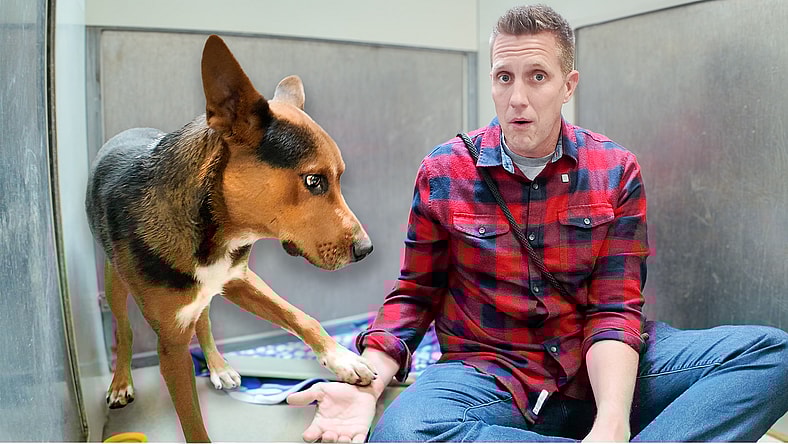
At first glance, Blaze looks like the kind of dog many people walk past without a second thought. When visitors arrive at Animal Friends of the Valleys in Wildomar, California, the 1 1/2 year-old shepherd mix often hangs back, unsure and conflicted, his tail swinging somewhere between nervous and hopeful.
On the surface he is stressed, pacing and uncertain. Give him a little time, though, and a very different dog appears. Behind the trembling and side-eye is a young dog that loves treats, leans into scratches and offers his paw for a shake.
Blaze has already spent a month in the shelter. For a sensitive dog like him, that is a long time.
Found Alone on the Street
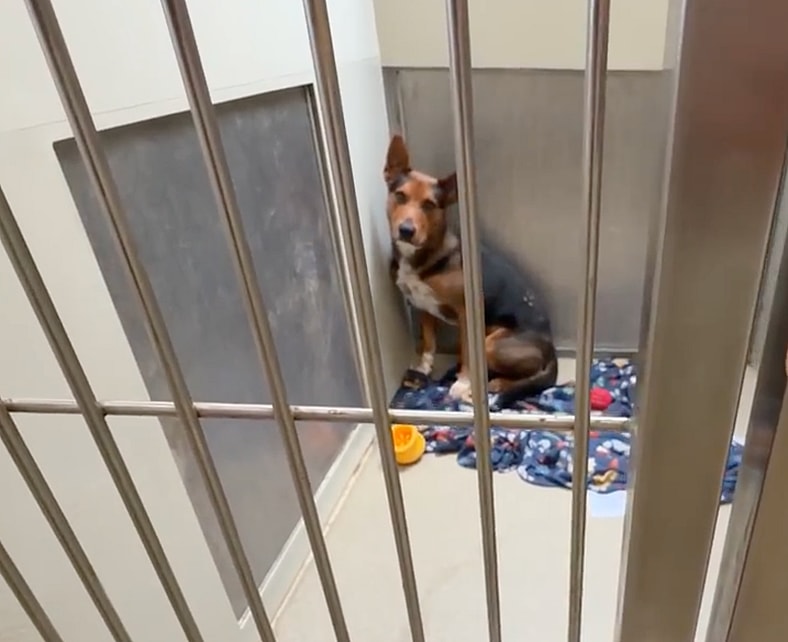
Blaze did not arrive as an owner surrender. According to shelter staff who shared his history with pet rescue advocate Rocky Kanaka and team member Alexis, Blaze was found loose on the street and brought into the shelter without a collar or microchip.
With no identification and no one coming forward to claim him, Blaze was made available for adoption. Physically, he is striking. Staff describe him as a shepherd mix, and Rocky notes possible cattle dog traits in his speckled paws and athletic build. His red face, sharp features and expressive ears give him an almost wolfish, soulful look.
Inside, though, he is still very much a puppy, full of potential but shaken by his circumstances.
The First Impression Problem
Like many anxious dogs in a noisy kennel environment, Blaze often does not show his best side when strangers approach. When Rocky first stepped into his kennel, Blaze hovered at the back, conflicted and unsure.
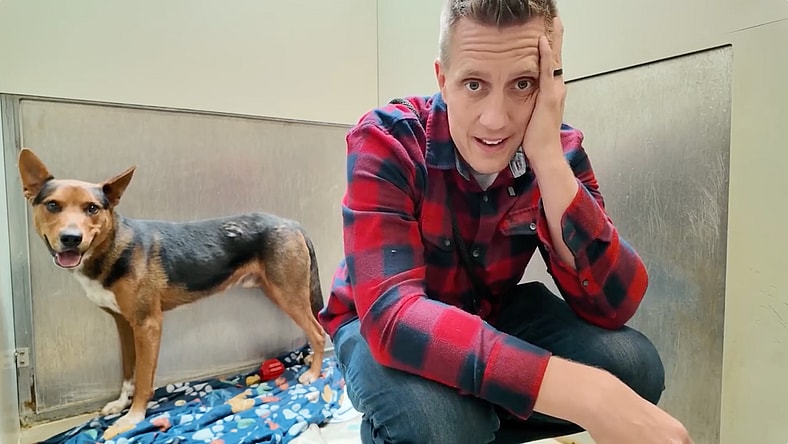
From outside the kennel, Rocky watched Blaze’s body language carefully, making sure the sudden bursts of interest did not flip into a fear bite. Even as Blaze crept closer, Rocky did not immediately reach to pet him. For dogs who are both scared and curious, one wrong move can be misread and escalate into a snap.
With patience and distance, Blaze began to investigate. He sniffed the leash without shrinking away, looked up into Rocky’s face and started to show flashes of joy between moments of hesitation. It was clear that fear was only part of his story.
Treats, Trust and Gentle Progress
Rocky used high value treats to test Blaze’s comfort level. First came tiny “finger treats,” offered with a flat, still hand at a distance. Blaze took them gently, using soft lips rather than grabbing or chomping.
For Rocky, that was an early clue that someone in Blaze’s past likely cared for him and fed him by hand. It is not proof of a perfect history, but it suggests he has experienced some kindness before landing in the shelter.
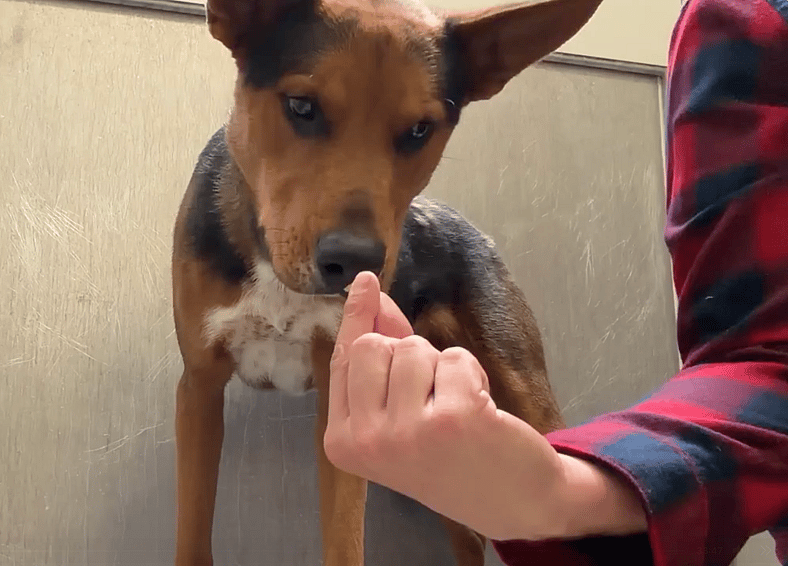
As he relaxed, Blaze accepted more treats and began to move closer. His tail wagged low and uncertain, sometimes swinging left in that nervous, stressed pattern Rocky later double checked with Alexis. Over the course of the visit, that tail slowly shifted into a looser, more balanced wag that signaled genuine happiness.
A Month in the Shelter and Stress-Linked Colitis
Alexis pulled Blaze’s file while Rocky worked with him in the kennel. The notes revealed two important details.
First, Blaze has already been in the shelter for about a month. At first Rocky assumed he was a new arrival because of how overwhelmed he looked. In reality, this anxious state has been building over weeks. Long shelter stays can be especially hard on sensitive dogs, and his behavior may now reflect the strain of that environment as much as his past.
Second, Blaze has been dealing off and on with colitis, an inflammation of the colon that can cause digestive issues. Alexis noted that stress is often a contributing factor, and in Blaze’s case the connection is easy to see. The shelter has already placed him on a special diet that is gentler on his stomach, an extra step that requires more effort and resources than feeding donated food alone.
To help further, Rocky reached out to Sundays for Dogs, a sponsor that has supported many of his cases. They agreed to provide their turkey recipe, formulated for dogs with sensitivities, for Blaze at the shelter and to cover a year of food for the family that adopts him.
The Dog Walking Program Is Keeping His Spirit Afloat

One reason Blaze has not completely shut down is the shelter’s dog walking program. Volunteers regularly take him out, and they record their observations on a walking sheet.
Blaze’s notes describe him as friendly, energetic, smart, trainable and well behaved. He pulls at first but then settles into the walk. He can be a bit mouthy when being collared, which fits with what Rocky saw, but overall he is labeled a level one walking dog, meaning he is easier and safer to handle than truly fearful or aggressive dogs.
The volunteers also note that Blaze loves scratches and knows some tricks. Those small details matter. They show that outside the kennel, with structure and movement, Blaze behaves like a normal, adoptable young dog.
From Nervous Wreck to Snuggle Buddy
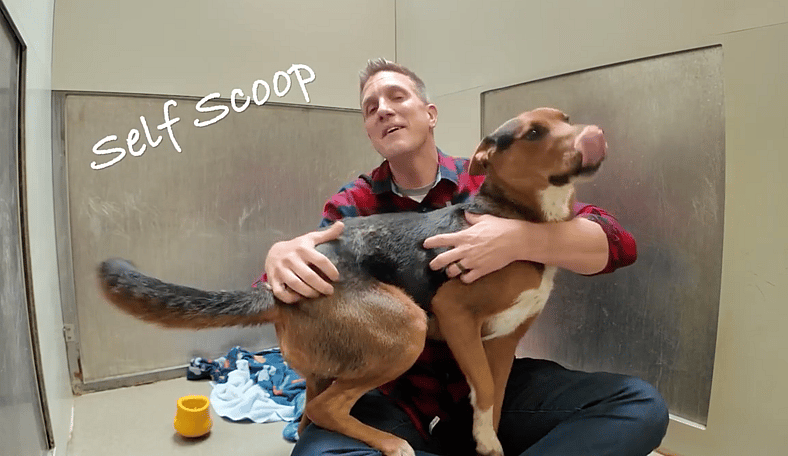
As Rocky spent more time with Blaze, he began positive affirmations and used the dog’s shelter name, which staff had chosen: Blaze.
The reaction was immediate. Hearing “Blaze” in a calm, encouraging tone seemed to ground him. He moved closer, accepted more touch and eventually climbed into Rocky’s lap, pressing his weight against him like a dog who had been craving contact.
Unlike some dogs Rocky works with, Blaze did not have a long list of behavior red flags once the initial fear softened. He was affectionate, responsive and eager to interact. He just needed someone to push through that stressful first impression.
A Grooming Session Reveals a New Dog
To help Blaze feel even better and look his best for potential adopters, Rocky asked if groomer Mel was available. Mel, a regular collaborator at Animal Friends of the Valleys, agreed to fit Blaze in for a bath and brush.

On the grooming table, Blaze shed heavily, a visible sign of the stress he had been carrying. At one point he caught sight of himself in the mirror and reacted with surprise, unsure who that “other dog” was staring back, a common and endearing response during first-time grooms.
After his bath and blow dry, Blaze looked like a different dog. His red coat shone, his white patches were crisp, and his body language was noticeably lighter. With a fresh bandana around his neck, he looked ready to meet a family instead of disappearing into the back of a kennel.
Blaze Is Ready for a Home
Blaze is still young, with an athletic build and plenty of energy. Any adopter will need to commit to regular exercise, mental stimulation and continued training, especially since he can be a little mouthy when collared and pulls at the start of a walk.

In return, they will get a dog who:
- Has already shown he can bond quickly once he feels safe
- Loves scratches and physical affection
- Takes treats gently and responds well to positive reinforcement
- Knows basic cues like sit and shake
- Has a year of premium food covered, thanks to Sundays for Dogs
He has already waited a month in the shelter. That is long enough.
Anyone interested in adopting Blaze can contact Animal Friends of the Valleys in Wildomar, California and ask about Blaze, the one-and-a-half-year-old shepherd mix in the dog walking program. For those outside the immediate area, Rocky notes that the team has been able to arrange transports for other dogs across the United States and even to Canada, so distance does not necessarily need to be a dealbreaker.
Blaze has done his part. He has survived the streets, learned to trust again inside a loud kennel and proved he can be both playful and gentle. Now he needs someone to walk past the front of the kennel, sit down, and give him what the shelter cannot provide forever: a home.